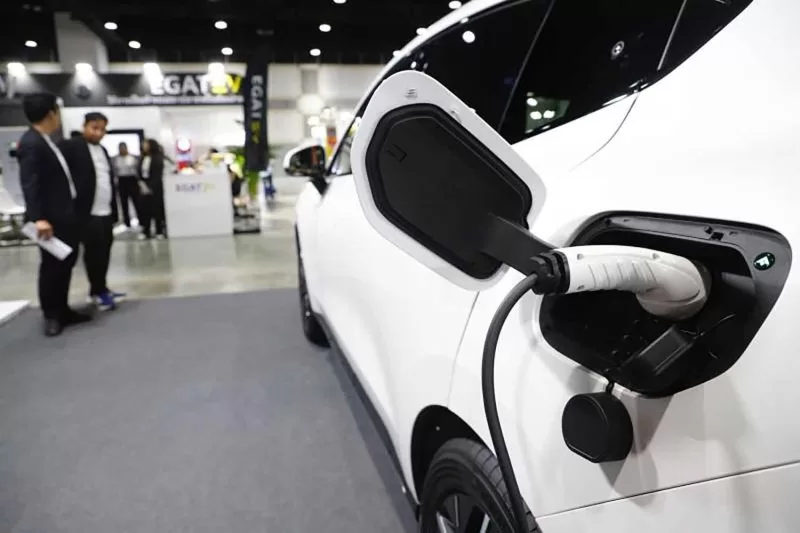
Thailand’s rapidly growing electric vehicle (EV) market is facing significant structural gaps that pose challenges to consumer rights, including battery safety risks, unclear warranty conditions, and unfair after-sales service, according to a new Thailand Consumer Council (TCC) study.
Researchers, led by Manon Suklamai of King Mongkut’s University of Technology Thonburi, surveyed more than 400 EV users and compared global regulatory practices as part of the study.
It found that Thai consumers remain exposed to multiple risks and called for stronger protection measures, including the introduction of “lemon laws” to ensure accountability from manufacturers. Lemon laws, found in countries such as the US, China, and Singapore, provide consumers with legal recourse if they are sold a defective vehicle.
“A product recall should not be seen as something alarming — it is a sign of responsibility from the manufacturer,” Mr Manon said. “Thailand urgently needs clear and comprehensive consumer protection mechanisms, and a lemon law is not about forcing replacements alone, but about improving product quality from production through to post-sale service.”
The study identified three key areas of concern: safety and lack of central standards — especially for battery systems, fire prevention, home charger installation and emergency response; unclear legal and after-sales frameworks — including vague warranty terms, slow claims processing, long waits for spare parts and complicated registration for modified or converted EVs; and economic instability and loss of consumer confidence — stemming from sudden price cuts on new models that devalue secondhand cars and increase debt burdens, along with uncertainty about the long-term presence of manufacturers and importers.
Researchers also found that the release of new EV models at high prices, followed by rapid price reductions, has left early buyers feeling shortchanged and undermined trust in the market.
This volatility not only affects consumers but also disrupts the broader automotive industry and financial stability, the researchers said.
The TCC study also compared Thailand’s situation with six other regions.
It found that Europe, China and the United States have established frameworks similar to the lemon law, requiring manufacturers and dealers to take responsibility for defective vehicles or those requiring frequent repairs.
Japan, meanwhile, enforces strict penalties on violators to prevent issues from occurring at the source, it said.
Thailand, by contrast, continues to face repeated consumer complaints and lacks any formal, preventive mechanism to protect EV buyers, it noted.
The research team proposes a comprehensive policy package involving coordination among multiple agencies to ensure fairness, safety and stability in the EV market.
Mr Manon said that lawsuits should be “the last resort” and that strong preventive policies are more crucial.
“If Thailand develops solid standards for manufacturing, conversions, installation, after-sales service and insurance — along with safety measures for charging stations and buildings — recurring EV problems will decline significantly,” he said.
He added that Thailand is now at a pivotal stage, transitioning from being a global car assembly hub to an EV production base, and must therefore focus on increasing local content and technology transfer to strengthen domestic industry and competitiveness.
The report concluded that implementing these measures would enhance consumer confidence, promote fairness, reduce safety and debt risks and help Thailand achieve its goal of becoming a sustainable regional hub for EVs.
The TCC is urging all relevant government agencies to integrate their efforts and act swiftly to turn these recommendations into concrete policy outcomes.